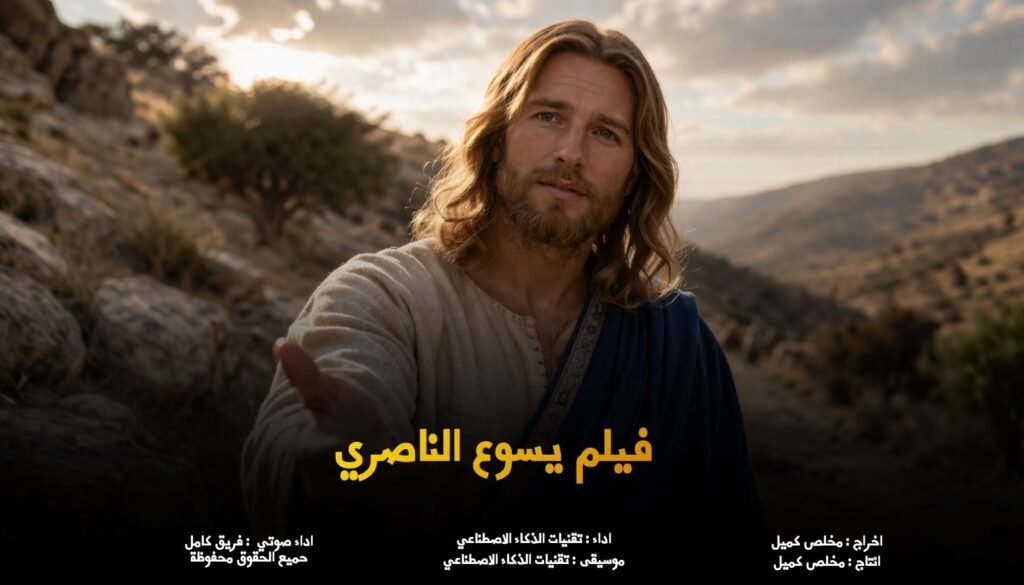
Jesus of Nazareth
A groundbreaking cinematic project is set to redefine the boundaries of storytelling and visual art. Jesus of Nazareth, a full-length feature film of approximately two hours, presents a bold and innovative interpretation of the Gospel of Matthew through the power of advanced artificial intelligence.
This production introduces a new approach to religious cinema — one that moves beyond traditional retelling and enters a realm of immersive, emotionally-driven storytelling. Rather than revisiting familiar scenes, the film explores previously unvisualized moments, offering a deeper and more human perspective on one of history’s most influential narratives.
A New Era of Filmmaking
Jesus of Nazareth is created using cutting-edge AI technologies that transform every stage of production. From scene generation to character animation, the film achieves a level of realism and detail that rivals major cinematic productions.
The project features:
- Hyper-realistic environments reconstructed with historical accuracy
- Advanced character expressions capturing subtle human emotion
- Cinematic camera movements designed to enhance immersion
- Ultra-high-definition visual quality with natural lighting and detail
This integration of technology allows for a seamless fusion between artistic vision and digital execution.
Unseen Depth and Perspective
At its core, the film focuses on the psychological and emotional dimensions of its characters. It highlights moments of vulnerability, endurance, and internal conflict, presenting a narrative that feels immediate and deeply human.
The storytelling emphasizes authenticity — not only in visuals, but in the emotional journey, bringing audiences closer than ever to the lived experience behind the text.
Redefining Expectations
This project stands apart from previous adaptations by offering a fresh cinematic language. It does not aim to replicate what has been done before, but to expand the possibilities of how such stories can be told.
By combining faith-based storytelling with advanced AI-driven production, Jesus of Nazareth represents a shift toward a new generation of filmmaking — one where creativity is no longer limited by traditional constraints.
Conclusion
Jesus of Nazareth is more than a film. It is a vision of the future of cinema, where technology and storytelling converge to create experiences that are both visually extraordinary and emotionally powerful.
The project is expected to set a new standard for AI-powered filmmaking and open the door to a new era of cinematic expression.
Jesus Christ – Analytical Character Description
The presence of Jesus Christ was not something that could be reduced to simple physical features such as eye color or facial structure. It was a deeply complex presence — a rare balance between the physical and the spiritual, between humility and authority.
Physical Build
According to the perspective of Abbas El Akkad, Jesus was not physically weak as often portrayed. Instead, he possessed a strong, resilient body shaped by endurance.
He was capable of walking long distances, living under harsh conditions, and تحمل physical hardship without dependence on comfort. His strength was not aggressive or showy — it was calm, controlled, and deeply rooted.
General Facial Features
His face carried a natural harmony — neither overly sharp nor excessively soft.
His skin appeared clear and healthy, with a subtle natural warmth.
There was no artificial perfection in his appearance, yet it held a quiet, undeniable attraction — a presence that could not be easily explained, only felt.
The Eyes – The Center of Influence
The eyes were the true source of his presence.
As described by El Akkad, the power of Jesus did not lie in physical form, but in the “authority of the spirit” reflected through his gaze.
A single look could evoke two opposite reactions at once:
a sense of awe in those who were troubled, and deep peace in those seeking comfort.
According to the traditional description attributed to historical texts, his eyes were exceptionally clear, often described as blue or gray — carrying a depth that felt beyond the visible world.
Hair and Beard
His hair was relatively long, reaching the shoulders, with a color similar to ripe chestnut — a brown with subtle reddish tones.
It fell smoothly around the ears and became slightly wavy toward the shoulders, parted naturally in the middle.
His beard was full and well-shaped, matching the color of his hair, and slightly divided at the center — adding to his dignified and composed appearance.
Psychological Presence
What truly defined his appearance was not the structure… but the essence behind it.
He embodied:
- Deep gentleness that radiated peace
- Firm strength when facing conflict
- A calm exterior with profound inner depth
This balance gave his face a form of beauty that transcended physical features — a beauty rooted in the soul.
Artistic Summary
Visually, Jesus can be imagined as:
A relatively tall man with a strong yet natural build,
A calm but deeply expressive face,
Eyes that carry an unexplainable emotional impact,
And an overall presence that feels simple… yet profoundly extraordinary.
The Role of the Twelve Disciples in the Gospel of Matthew
Core Characters in Jesus of Nazareth
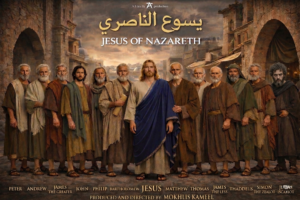
In the narrative structure of Jesus of Nazareth, the story is not carried by a single figure alone. While Jesus Christ stands as the central protagonist, the emotional and human depth of the film is profoundly shaped by the presence of the Twelve Disciples, alongside the Virgin Mary.
Drawn directly from the Gospel of Matthew, these figures are not secondary characters — they are essential pillars of the story, each representing a different facet of the human experience in the presence of the divine.
The Disciples as Living Reflections of Humanity
The Twelve Disciples are portrayed not as perfect followers, but as deeply human individuals navigating faith, doubt, fear, and transformation.
Each disciple embodies a unique psychological and emotional journey:
- Faith mixed with uncertainty
- Courage tested by fear
- Loyalty challenged by circumstance
Through them, the audience does not merely observe the story — they enter it.
Individuality Within Unity
The Gospel of Matthew presents the disciples as a unified group, yet each carries a distinct personality and role.
Figures such as Simon Peter represent impulsive faith and emotional intensity, often acting before thinking, yet holding deep devotion.
Others like John the Apostle embody spiritual sensitivity and closeness, reflecting a quieter, more contemplative connection.
Meanwhile, Judas Iscariot stands as one of the most complex figures — representing internal conflict, moral struggle, and the tragic dimension of human choice.
This diversity transforms the group into a mirror of humanity itself.
The Disciples in the Film Narrative
In Jesus of Nazareth, the disciples are not placed in the background. They are central to the cinematic experience.
The film highlights:
- Their daily interactions with Jesus
- Their reactions to miracles and teachings
- Their internal struggles as events intensify
- Their transformation from followers into witnesses
The audience sees not only what happens… but how it affects those closest to it.
The Presence of the Virgin Mary
Alongside the disciples, Mary, mother of Jesus holds a powerful and emotionally grounding role.
She represents:
- Silent strength
- Deep sorrow and endurance
- Unshaken faith
Her presence adds a layer of emotional gravity, particularly in moments of suffering, making the story more intimate and human.
Jesus Christ – The Central Figure
At the heart of the film stands Jesus Christ — not only as a religious figure, but as the central force that shapes every character around him.
His influence is not imposed, but revealed through:
- His words
- His actions
- His presence
Every disciple, every moment, every transformation revolves around him.
A Narrative Built on Relationships
What makes this film unique is its focus on relationships rather than events alone.
The connection between:
- Jesus and his disciples
- The disciples among themselves
- Mary and her son
creates a layered narrative that moves beyond storytelling into emotional experience.
Conclusion
In Jesus of Nazareth, the Twelve Disciples are not supporting roles — they are core characters, each carrying a piece of the story’s soul.
Together with the Virgin Mary and Jesus Christ as the central protagonist, they form a complete human and spiritual framework that brings the Gospel of Matthew to life in a way that is both authentic and deeply moving.
This is not just a story about what happened —
it is a story about people who lived it.
Produced & Directed by | Mokhlis Kameel